In commemoration of the 100th anniversary of the birth of quantum mechanics, the 2025 Nobel Prize in Physics was awarded to John Clarke, Michel H. Devoret, and John M. Martinis for their groundbreaking experimental work on quantum tunneling effects and energy-level quantization in macroscopic circuit systems.
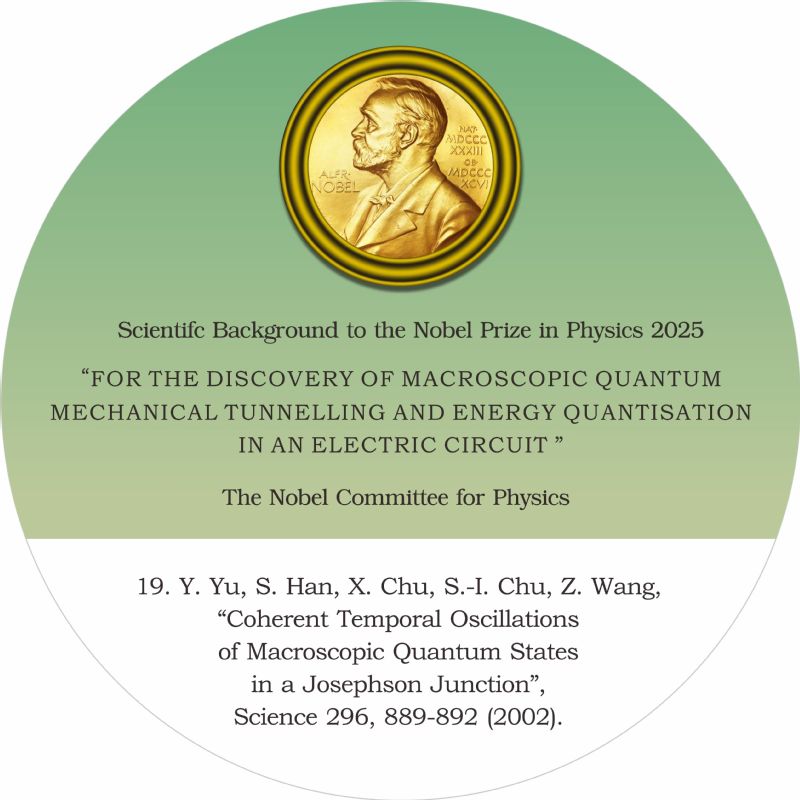
The official Nobel Prize in Physics committee also released a Scientific Background document, which elaborates on the scientific significance of the award-winning achievements in 12 pages. The document cites 27 academic papers, two of which are first-authored by Chinese scientists: Professor Yu Yang, a professor at the Department of Physics of Nanjing University and director of the Shishan Quantum Laboratory, and Professor Jianqiang You from Zhejiang University. This highlights the indispensable contributions of Chinese scientists in the field of macroscopic quantum effects.
In the early 2000s, during his doctoral studies under the guidance of Chinese-American scholar Professor Siyuan Han at the University of Kansas, Professor Yu Yang focused on experimentally realizing macroscopic quantum phenomena in superconducting quantum circuits and addressing coherence issues in the phase qubit. Through innovative device structure design and optimized material and environmental control schemes, he significantly extended the coherence time of superconducting quantum circuits, observed macroscopic quantum coherent oscillations, and realized the world’s first phase qubit. The findings were published in Science. In the same issue, Anthony Leggett, winner of the 2003 Nobel Prize in Physics, authored a Perspective article, noting that this work overcame decoherence obstacles and laid a crucial experimental foundation for the study of macroscopic quantum effects and the development of quantum computing prototypes.
This article is translated from Department of Physics of Nanjing University