Recently, the School of Physics of Nanjing University and its collaborators have made significant progress in the research of strongly correlated quantum states. For the first time, the research team experimentally identified a new strongly correlated state in an unexplored regime dubbed the "transdimensional" range, and observed an unprecedented anomalous Hall effect within it. This effect couples not only to out-of-plane orbital magnetization but also to in-plane orbital magnetization, giving rise to distinct hysteresis loops of Hall resistance under both in-plane and out-of-plane magnetic fields. This discovery breaks the conventional fundamental framework of the anomalous Hall effect, where magnetization, electric current and Hall electric field are mutually orthogonal, and unveils novel physics arising from the combined effects of interlayer coherence and electron correlations in quantum materials within the transdimensional regime. The relevant findings, titled Transdimensional anomalous Hall effect in rhombohedral thin graphite, were published online on April 29, 2026, in Nature, one of the world's top academic journals.
The experimental part of this work was completed by the research group led by Wang Lei from Nanjing University, in collaboration with the team of Zhao Yue from Southern University of Science and Technology and the group of Yu Geliang from Nanjing University. The theoretical part was mainly accomplished by the research group led by Liu Jianpeng from ShanghaiTech University. Academician Xie Xincheng and Dr. Jiang Hua from Fudan University provided important theoretical guidance. Nanjing University serves as both the first author institution and the primary corresponding author institution, and Shishan Quantum Computation and Quantum Detection Laboratory is also listed as an affiliated institution. Dr. Li Qingxin from the School of Physics of Nanjing University, Dr. Fan Hua from Southern University of Science and Technology and Dr. Li Min from ShanghaiTech University are the co-first authors of the paper. Professor Wang Lei and Professor Yu Geliang from the School of Physics of Nanjing University, Associate Professor Liu Jianpeng from ShanghaiTech University and Associate Professor Zhao Yue from Southern University of Science and Technology act as co-corresponding authors. This research was supported by the National Natural Science Foundation of China, the National Key R&D Program of China, Jiangsu Center for Physical Sciences, the Natural Science Foundation of Jiangsu Province, Hefei National Laboratory and Huairou Laboratory of Extreme Conditions, Chinese Academy of Sciences, to which we express our sincere gratitude.
The anomalous Hall effect is one of the classic transport phenomena in condensed matter physics and a crucial window for understanding the interplay between magnetic order and electronic orbital motion. Unlike the ordinary Hall effect which requires an external magnetic field, the anomalous Hall effect can emerge under zero external magnetic field, generally indicating that time-reversal symmetry is spontaneously broken within the system. It stands as a core research topic in the study of topological states and magnetic transport, and is also regarded as having great potential for low-power electronic devices. In recent years, the successive discoveries of the integer and fractional quantum anomalous Hall effects have further demonstrated the unique value of anomalous Hall physics in exploring new quantum states. In conventional magnetic materials, the anomalous Hall effect is generally associated with spin-orbit coupling: the magnetism of electron spins affects orbital motion via spin-orbit coupling, thereby generating orbital magnetization and Hall response. Twisted moiré systems have revealed another mechanism in recent years. Even with extremely weak spin-orbit coupling, strong Coulomb interactions can drive orbital ferromagnetism, spontaneously break time-reversal symmetry and give rise to the anomalous Hall effect. Nevertheless, regardless of whether orbital magnetization originates from spin-orbit coupling or electron correlations, all known anomalous Hall effects and quantum anomalous Hall effects share a common feature. They essentially stem from out-of-plane orbital magnetization corresponding to the in-plane orbital motion of electrons, and follow the orthogonal relationship where the directions of magnetization, electric current and Hall electric field are mutually perpendicular, expressed as M ∝ J × EH.
However, re-examining this issue from a dimensional perspective reveals a long-overlooked possibility. In strictly two-dimensional systems, electronic orbital motion is largely confined to the plane, so the anomalous Hall effect is only coupled to out-of-plane orbital magnetization (Fig. 1a, d). In three-dimensional systems, although electrons can move along the third dimension, when the sample thickness is much larger than the coherent transport length, interlayer coherent orbital motion is rapidly disrupted by scattering and decoherence, and its anomalous Hall response is essentially an average of two-dimensional responses along the thickness direction (Fig. 1b, d). All previously known systems exhibiting the anomalous Hall effect and quantum anomalous Hall effect fall into these two categories and comply with the formula M ∝ J × EH. The truly unexplored regime lies in the intermediate "transdimensional" range: the samples are no longer atomically thin layers, yet not thick enough to completely lose interlayer coherence. In this new regime, electrons can undergo coherent orbital motion both in-plane and out-of-plane simultaneously, which may give rise to an entirely new type of anomalous Hall effect coupled with both in-plane and out-of-plane orbital magnetization (Fig. 1c, f). This not only represents a novel transport response, but also points to brand-new physics and quantum states distinct from the conventional two-dimensional and three-dimensional limits.
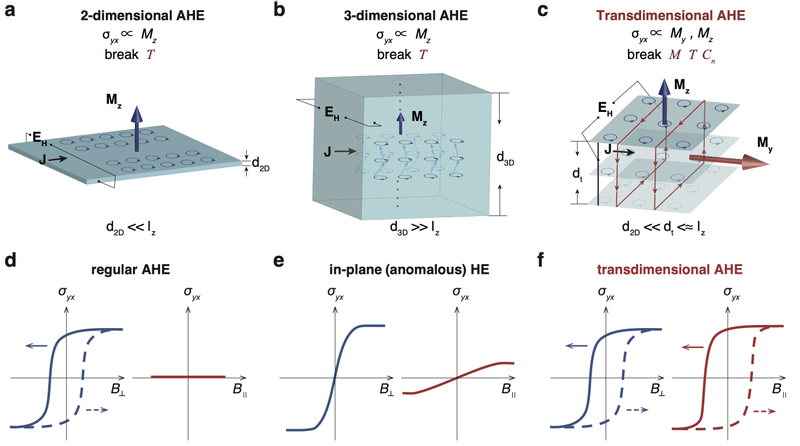
Figure 1. (a) Two-dimensional anomalous Hall effect; (b) Three-dimensional anomalous Hall effect; (c) Dimension-varying anomalous Hall effect, accompanied by out-of-plane and in-plane orbital loop currents as well as orbital magnetization. (d) Conventional anomalous Hall effect only shows out-of-plane magnetic hysteresis; (e) The in-plane Hall effect presents a linear Hall response driven by parallel external magnetic fields; (f) The dimension-varying anomalous Hall effect exhibits obvious magnetic hysteresis under both out-of-plane and parallel magnetic fields.
To explore this novel effect, Professor Wang Lei's research team adopted rhombohedral-stacked graphite with a thickness of 2 to 5 nanometers as the research platform. Rhombohedral multilayer graphene features nearly flat low-energy bands and a high density of states. An applied displacement field can further modulate the van Hove singularity and the shape of the Fermi surface, greatly enhancing electron-electron interactions. In such flat-band systems, spontaneous symmetry breaking readily occurs for the spin, valley and orbital degrees of freedom of electrons, which may lead to the formation of orbital loop currents and spontaneous orbital magnetism. The researchers first mapped the phase diagram in the two-dimensional parameter space of carrier density and displacement field based on nine-layer rhombohedral graphene devices. Apart from the known metallic phases with spontaneous symmetry breaking, they identified a distinctive region (Fig. 2a). Located between two quarter-metallic phases and one partial isospin-polarized phase, this region barely exhibits conventional Shubnikov–de Haas oscillations, and no Landau level structure emerges even under a perpendicular magnetic field of 13 Tesla. These anomalous characteristics indicate that this region is not a conventional metallic state, but a new ground state stabilized by strong electron correlations.
Focusing on this anomalous phase, Professor Wang Lei's team further conducted transport measurements under parallel and perpendicular magnetic fields, achieving the core finding of this work. Hall resistance presents hysteresis loops not only under perpendicular magnetic fields, but also shows distinct and prominent hysteresis loops under parallel magnetic fields (Fig. 2b and c). In other words, this is an anomalous Hall effect coupled with both in-plane and out-of-plane orbital magnetization in multilayer rhombohedral graphene, whose most direct experimental signature is the pronounced hysteresis of Hall resistance under both parallel and perpendicular magnetic fields. The research team thoroughly ruled out experimental artifacts such as residual perpendicular components during parallel magnetic field measurements, confirming that the hysteresis signal is intrinsic. The new phenomenon was named the dimension-varying anomalous Hall effect. Compared with the anomalous Hall response in conventional Stoner-type ferromagnetic metals, this effect demonstrates strong in-plane orbital ferromagnetism for the first time, marking a major expansion of the fundamental framework of the anomalous Hall effect.
Furthermore, through systematic comparisons of devices with different thicknesses and theoretical calculations, the research team uncovered the physical origin of this novel phenomenon. Experiments show that the dimension-varying anomalous Hall effect does not exist across all thicknesses, but only within a limited intermediate thickness window. Samples that are too thin approach the strict two-dimensional limit, while overly thick samples suffer disrupted interlayer coherent orbital motion due to decoherence. Only within this intermediate "transdimensional" regime can electrons maintain coherent orbital motion both in-plane and out-of-plane simultaneously. Further theoretical calculations (Fig. 2d) reveal that under appropriate carrier density and displacement field conditions, electron-electron interactions drive the system to spontaneously break time-reversal, rotational and mirror symmetries, giving rise to a unique orbital ferromagnetic metallic state. In this new quantum state, out-of-plane and in-plane loop currents emerge concurrently inside the system, corresponding to out-of-plane and in-plane orbital magnetization respectively, which ultimately produce this brand-new anomalous Hall response.
The team also investigated the temperature evolution of this state and found that the hysteresis signals under parallel and perpendicular magnetic fields fade away at distinctly different temperatures. The hysteresis associated with in-plane orbital magnetization under parallel magnetic fields disappears at around 1.6 K, while the hysteresis related to out-of-plane magnetization under perpendicular magnetic fields persists up to approximately 4 K. This indicates that although the two types of magnetization coexist within the same electronic phase, they do not originate from identical intrinsic mechanisms. The in-plane orbital magnetization relies on the interlayer coherent orbital motion unique to the transdimensional regime, whereas the out-of-plane magnetization bears more resemblance to the Stoner-type isospin ferromagnetism reported in previous studies. The presence of two distinct critical temperatures provides direct and crucial experimental evidence for distinguishing these two mechanisms.
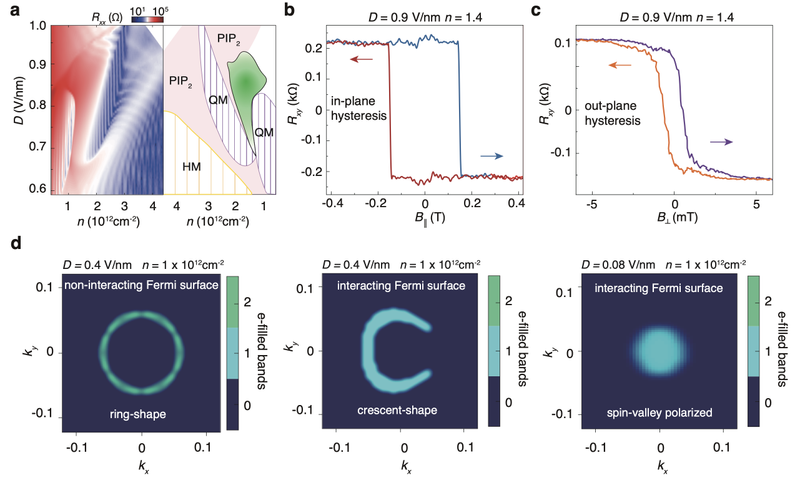
Figure 2. (a) The region (in green) corresponding to the dimension-varying anomalous Hall effect in the n-D phase diagram. (b) & (c) Hysteresis loops of Hall resistance Rxy measured during parallel and perpendicular magnetic field sweeps. (d) Theoretically calculated Fermi surfaces. The middle one represents the orbital ferromagnetic state with crescent-shaped Fermi surface driven by long-range Coulomb interactions, which is a necessary condition for the generation of the dimension-varying anomalous Hall effect.
This work experimentally reveals for the first time a new paradigm of transdimensional electronic transport defined by finite thickness and interlayer coherence, which differs from the conventional two-dimensional and three-dimensional limits. It not only discovers a brand-new type of anomalous Hall effect, but more importantly, identifies a novel orbital ferromagnetic state stabilized jointly by strong electron correlations, orbital loop currents and interlayer coherence. This breakthrough extends the understanding of the anomalous Hall effect beyond the traditional two-dimensional/three-dimensional dichotomy to an entirely new dimensional regime, and paves a new avenue for exploring strongly correlated orbital physics in multilayer graphene and a broad range of van der Waals quantum materials.
Paper Link:
https://www.nature.com/articles/s41586-026-10471-1

This is Professor Wang Lei's 11th paper published in top-tier journals. Wang Lei is a Professor at the School of Physics, Nanjing University, Deputy Director of the National Laboratory of Solid State Microstructures, and a Young Leading Scholar at Shishan Quantum Computation and Quantum Detection Laboratory. He has long been engaged in research on electrical transport properties of two-dimensional quantum materials. The pick-up transfer and stacking technique for two-dimensional materials invented by him has boosted the emergence and development of van der Waals heterostructures based on two-dimensional materials. To date, Professor Wang Lei has authored more than 70 SCI papers, including 35 articles in Nature, Science and their sister journals (6 in Science and 5 in Nature), with a total citation of over 30,000 times.

Yu Geliang is a Professor at the School of Physics and the National Laboratory of Solid State Microstructures, Nanjing University. He studied under Andre Geim, Nobel Laureate in Physics for research on graphene. His research has long focused on high-mobility two-dimensional materials and semiconductor devices. He was the first to achieve an electron mobility of ten million level in two-dimensional materials and realize wafer-scale fabrication of two-dimensional semiconductor sensors. Up to now, Professor Yu Geliang has published over 70 SCI papers, including works in Nature, Science, their sister journals and PNAS.