Recently, the research team led by Professor Yu Yang from the School of Physics of Nanjing University and Shishan Quantum Computation and Quantum Detection Laboratory has achieved important progress in the field of high-dimensional superconducting quantum computing. The research team theoretically proposed and experimentally verified a novel scheme to realize single-qutrit gates in a single step via coherent control, successfully overcoming the physical bottleneck in the efficient implementation of native qutrit gate sets. This work not only breaks the inherent selection rule constraints of quantum platforms, but also drastically improves the operation speed of quantum gates and the compilation efficiency of quantum circuits, paving a practical and feasible route for constructing high-performance ternary quantum processors on various quantum hardware. This achievement, titled "Efficient Implementation of a Single-Qutrit Gate Set via Coherent Control", was published online on June 12, 2026 in Physical Review Letters [Physical Review Letters 136, 230803 (2026)].

Conventional quantum computers mainly rely on two-state qubits to process information. By contrast, qutrits with three energy levels can offer a much larger computational space. Thanks to such high-dimensional characteristics, a single quantum system is capable of carrying more information, substantially saving hardware resources and reducing quantum circuit depth. Nevertheless, in the practical manipulation of high-dimensional quantum systems, physical platforms are constrained by selection rules, posing severe challenges to the realization of high-fidelity, fast qutrit quantum gates (namely SU(3) operations. Conventional schemes generally decompose SU(3) operations into a series of low-dimensional SU(2) sub-operations. This results in lengthy and slow operation sequences, while errors continuously accumulate across multi-step gate sequences, ultimately undermining the inherent advantages of ternary quantum computing. Moreover, although existing optimal control techniques are viable in principle, they usually consume massive computational resources and require tedious calibration tailored to specific hardware, making them difficult to scale up for large-scale quantum processors.
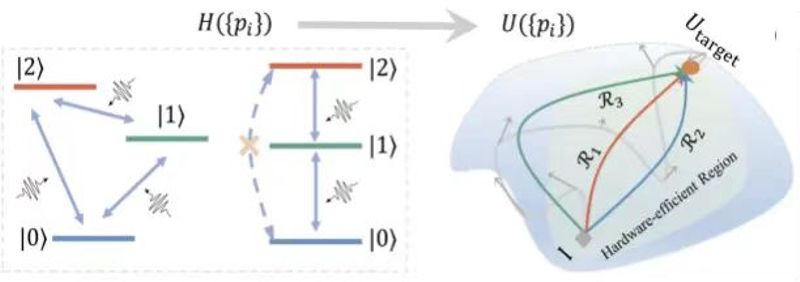
Figure 1. Coherent control scheme for single-step implementation of qutrit gates
To address this issue, the research team innovatively developed a scheme to directly manipulate SU(3) dynamical evolution via dual-frequency coherent driving. As illustrated in Figure 1, this scheme analytically solves the dynamical evolution trajectories constrained by selection rules to construct qutrit quantum gates in a single step. It fundamentally eliminates lengthy operation sequences originating from SU(2) decomposition and bypasses the complicated iterative search required by optimal control techniques.This scheme delivers outstanding efficiency gains in quantum compilation. For instance, when constructing the three-dimensional Clifford gate set, this method cuts the average number of native physical gates needed from 5.25 to 1.667, boosting compilation efficiency by 68.2%. Furthermore, the team proposed a universal SU(3) decomposition strategy, which reduces the physical gate overhead for synthesizing arbitrary SU(3) operations by one third compared with conventional approaches.
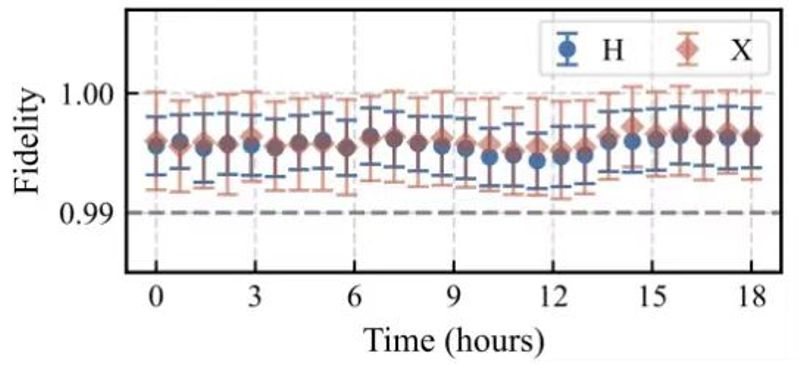
Figure 2. Long-term stability of qutrit gate fidelity
As a proof-of-principle demonstration, the research team constructed qutrits using three energy levels of superconducting transmon devices and realized the qutrit Hadamard (H) gate and X gate with a gate duration of 35 ns each. Characterized via randomized benchmarking, both types of gates achieved an average fidelity of 99.5%, approaching the decoherence limit. The performance remained stable over continuous repeated measurements spanning 18 hours, verifying the exceptional long-term reliability of this scheme on current hardware (Figure 2). Meanwhile, the team also carried out qutrit Ramsey interference experiments and parity-check algorithms, illustrating the application potential of the proposed protocol (Figure 3).
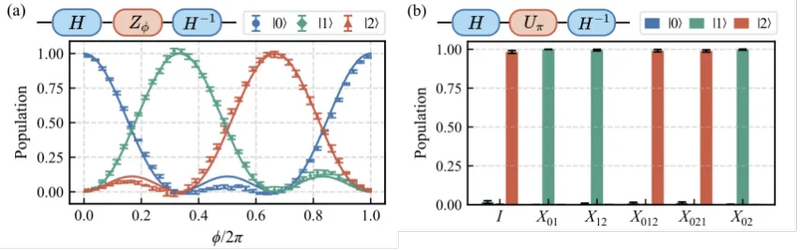
Figure 3. Demonstration of quantum algorithms based on qutrits
Yu Xiangmin, Deng Xiang and Xin Wei, PhD candidates from the School of Physics, Nanjing University, are the co-first authors of this paper. Postdoctoral researcher Zheng Wen, Researcher Li Shaoxiong and Professor Yu Yang from Nanjing University serve as the co-corresponding authors.This research was carried out relying on platforms including the School of Physics of Nanjing University, National Laboratory of Solid State Microstructures, Shishan Quantum Computation and Quantum Detection Laboratory, Jiangsu Key Laboratory of Quantum Information Science and Technology, and Hefei National Laboratory. The work was supported by the National Key Research and Development Program of Quantum Science and Technology, the National Natural Science Foundation of China, the Natural Science Foundation of Jiangsu Province and the Natural Science Foundation of Shandong Province.
Paper Link: