Recently, an international research team led by Professor Lingjie Du from the School of Physics, Nanjing University, based on gallium arsenide quantum wells, has for the first time observed emergent partons in the fractional quantum Hall effect and unveiled their intrinsic geometric dynamics. The experiment verifies that electrons can split into multiple constituent partons under specific extreme quantum conditions. This groundbreaking discovery not only broadens humanity’s understanding of quantum matter, but also unlocks a new paradigm for manipulating electrons in semiconductor systems: beyond controlling charge and utilizing spin, researchers can now harness the internal "split identity" of electrons, paving novel avenues for topological quantum computing.
This research, titled Emergent partons in fractional quantum Hall systems, was published on June 22, 2026, in Nature Physics, one of the world’s top academic journals.
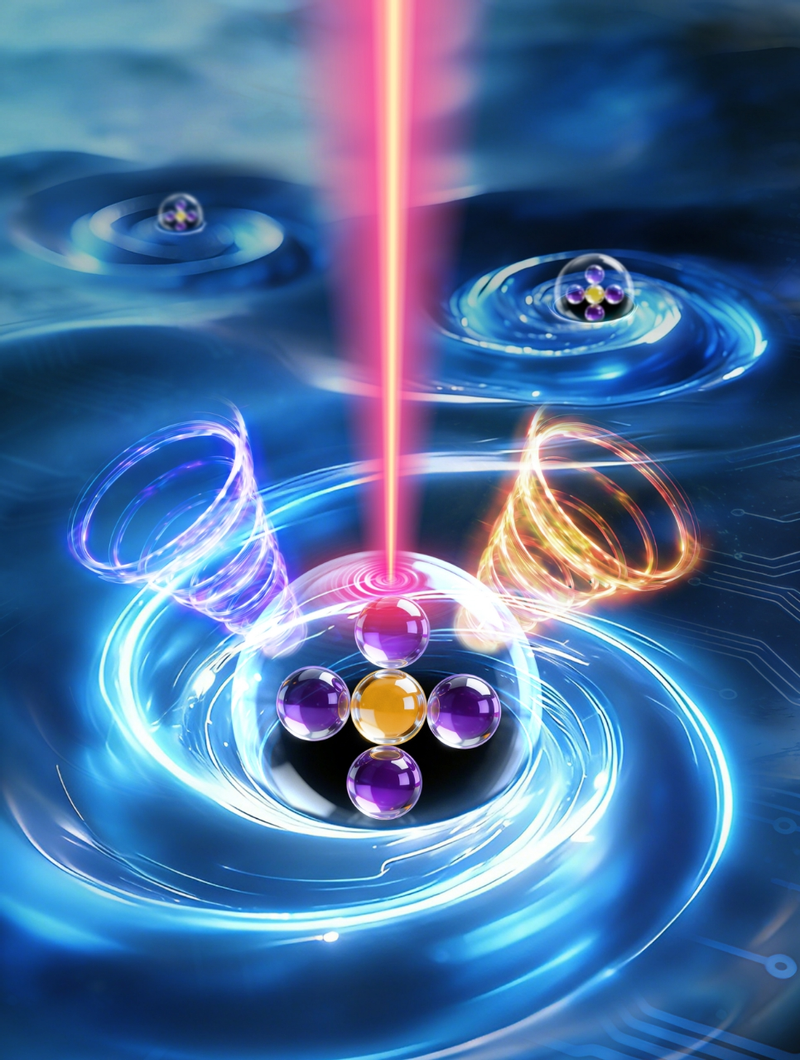
Are electrons divisible? In particle physics experiments, the electron has long been regarded as an elementary particle with no internal substructure. However, this established consensus gains a brand-new interpretation under extreme quantum conditions. For the first time, Professor Lingjie Du’s team and collaborators experimentally demonstrated that when massive electrons form strongly correlated quantum collective fluids at ultra-low temperatures and intense magnetic fields inside semiconductors, individual electrons behave as multiple independent partons. The phenomenon can be analogized to a musician in a symphony orchestra: instead of hearing a solo performance, listeners perceive multiple simultaneous melodic lines. Crucially, electrons are not physically cut apart; rather, they manifest as multiple quasi-independent "sub-units" within correlated quantum many-body systems.
The concept of partons was originally proposed by Nobel laureate Richard Feynman in the 1960s to describe the internal structure of protons, with quarks serving as a classic type of fractionally charged parton. Later, theoretical physicists extended the parton framework to condensed matter physics to explain the fractional quantum Hall effect, proposing that electrons can emergently "fragment" into several fractionally charged partons (quasiparticles) in strongly correlated electronic systems. As Nobel laureate Philip Anderson pointed out, each hierarchical layer of nature hosts unique laws and phenomena; a collective ensemble of electrons can exhibit properties absent in standalone electrons, a core phenomenon known as emergence. For decades after this theoretical prediction, however, direct experimental evidence of partons in fractional quantum Hall systems remained elusive, with the parton model merely serving as a mathematical tool.
In 2024, the team led by Lingjie Du at Nanjing University detected chiral graviton modes via circularly polarized resonant inelastic light scattering (CP-RILS) (Nature 628, 78 (2024), Figure 1). In the experiment, photons coupled to the two-dimensional strongly correlated electron fluid inside gallium arsenide quantum wells and excited intrinsic geometric oscillations of the electron liquid. Nevertheless, only one active species of parton existed in the fractional states studied at that stage, yielding a single type of graviton signal. It was therefore impossible to distinguish whether the observed geometric oscillations originated from bare electrons or emergent partons. Though chiral gravitons had been detected, whether partons could generate uniquely identifiable experimental signatures remained an open question.
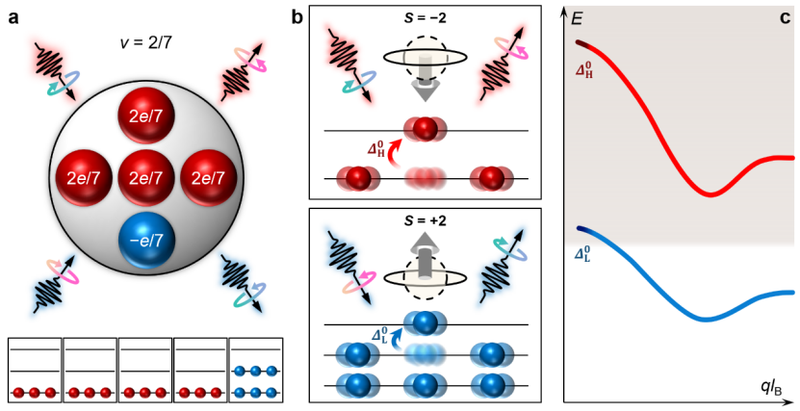
Figure 1. Parton configurations and corresponding graviton modes of fractional quantum Hall states
To capture unambiguous signatures of partons, the team deployed CP-RILS to irradiate fractional quantum Hall electron fluids hosted in GaAs semiconductor quantum wells and analyze scattered photon signals. Within a single fractional state, two distinct graviton resonances were resolved—one low-energy and one high-energy, with an energy ratio of nearly three and opposite chiral spin characteristics. As Professor Du explained, geometric oscillations originating solely from bare electrons cannot produce two independent graviton modes, much like a single bell cannot simultaneously emit high and low tones. This observation directly confirms the coexistence of two distinct parton species.
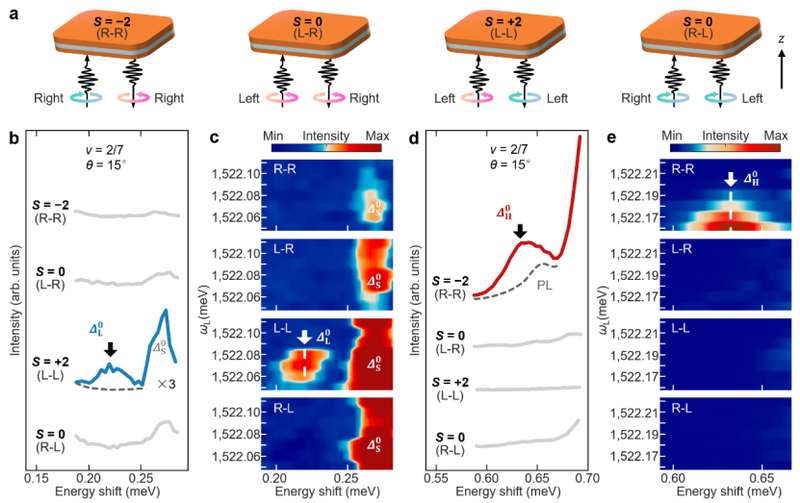
Figure 2. Measurements of multiple graviton modes at filling factor ν = 2/7
The group further tuned external magnetic conditions to consolidate conclusive proof. When the two parton types experienced effective magnetic fields of opposite directions, the two graviton modes exhibited reversed spin chiralities; when the effective fields aligned identically, both gravitons carried the same spin sign. These results strongly validate the parton picture: geometric fluctuations of distinct partons generate gravitons with chiralities matching the direction of the effective magnetic field each parton senses.
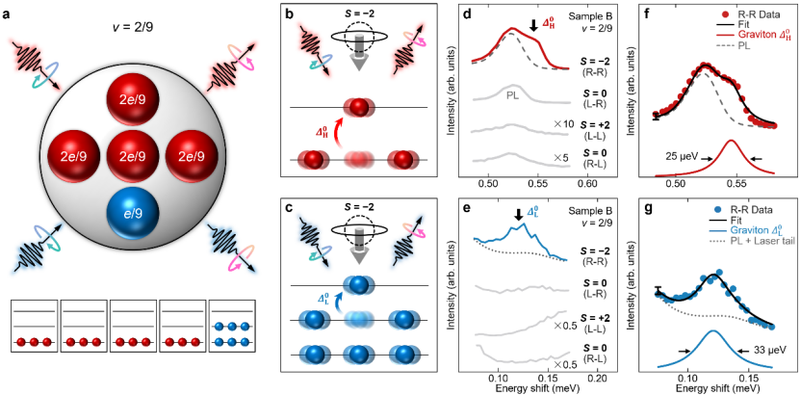
Figure 3. Measurements of multiple graviton modes at filling factor ν = 2/9
The team conducted an additional control experiment by engineering one type of parton to become charge-neutral. The graviton signal associated with neutral partons vanished completely, while the signal from charged partons persisted—comparable to silencing one section of an orchestra while other instrumental voices remain audible. This set of evidence definitively proves that the two graviton resonances stem from separate parton species, experimentally confirming that correlated electrons can fragment into multiple fractionally charged emergent quasiparticles.
An even more striking result emerged from the limiting case of the parton construction: low-energy neutral partons do not support graviton excitations, while high-energy fractionally charged partons retain geometric fluctuation capabilities and produce distinct high-energy graviton modes. This reveals that hidden bosonic Laughlin states formed by high-energy partons can survive even within gapless quantum Fermi liquids, leaving clear spectroscopic fingerprints via chiral gravitons. This observation delivers pivotal experimental validation for the parton theory and establishes a new spectroscopic strategy to uncover hidden fractional quantum Hall phases.
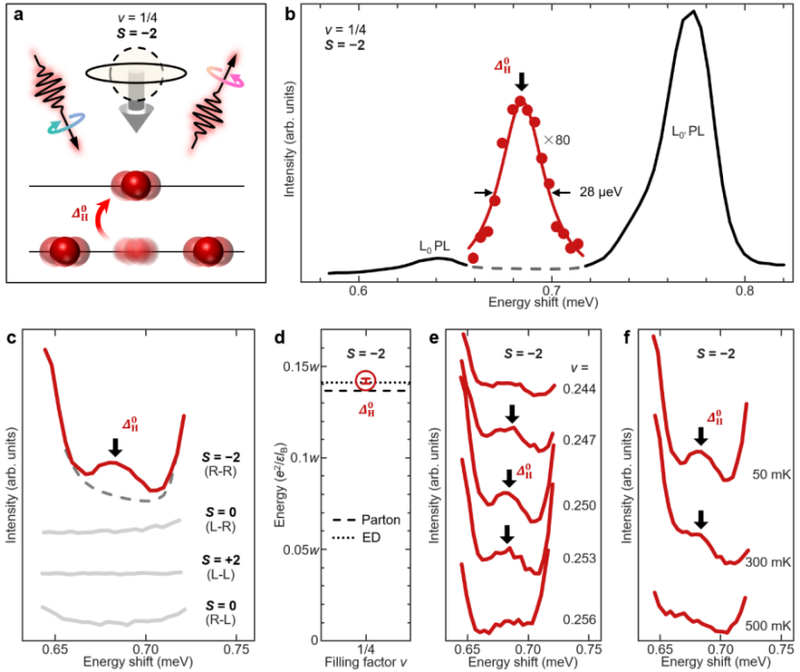
Figure 4. High-energy graviton measurement in the gapless ν = 1/4 composite Fermi liquid state
Looking back on the evolution of information technology, every transformative leap stems from deeper understanding of the electron. The 1.0 information era revolved around charge control, enabling integrated circuits and modern computers. The 2.0 era leveraged electron spin, laying the foundation for quantum computing. This experiment marks the first realization of harnessing the internal split substructure of correlated electrons within semiconductors. From charge manipulation and spin utilization to parton control, every fundamental physics breakthrough expands our comprehension of nature and fuels the next wave of technological revolution.
Paper link:
https://www.nature.com/articles/s41567-026-03338-9
Zihao Yang and Yifan Wang, PhD candidates from the School of Physics, Nanjing University, are co-first authors of this paper. Professor Lingjie Du, School of Physics, Nanjing University, Young Leading Scholar of Shishan Quantum Computation and Quantum Detection Laboratory, serves as the corresponding author.All experimental measurements were completed by Professor Lingjie Du’s research group at Nanjing University. High-quality heterostructure samples were provided by Professor L. N. Pfeiffer’s group at Princeton University, USA. Theoretical calculations were performed by Professor Bo Yang (Nanyang Technological University, Singapore) and Dr. Ajit C. Balram (Institute of Mathematical Sciences, India).This work was supported by the long-term national basic research program, the Climbing Program and Key Projects of the Natural Science Foundation of Jiangsu Province, the Jiangsu Dual Innovation Talents Team Program, Nanjing University’s 789 Key Research Initiative, and the Jiangsu Physical Science Research Center.